

Table of Contents
- Why Accurate Chest Measurements Matter for Dog Gear
- What You'll Need Before You Start Measuring
- Step-by-Step: How to Measure Dog Chest Size
- How to Measure Dog Girth (and Why It's the Same Thing)
- How to Measure a Dog for a Harness
- How to Measure a Dog for Clothes
- Using a Dog Clothing Size Chart Correctly
- Conclusion
- Frequently Asked Questions
Last Updated: October 16, 2026
Why Accurate Chest Measurements Matter for Dog Gear
Getting the right fit starts with one number: chest girth. Learning how to measure dog chest size takes about two minutes, but it decides whether a harness rubs, a hoodie pulls, or a coat stays on during a beach walk.
The Cost of Guessing: Returns, Discomfort, and Safety
A too-tight harness digs into the armpits and limits front-leg reach. A too-loose one slides sideways, and a dog can back out of it near traffic or water. Clothing that pinches across the rib cage gets chewed off within minutes.
- Returns: wrong-size orders get shipped back, wasting your time and money
- Discomfort: tight straps cause chafing behind the front legs
- Safety: loose harnesses let dogs slip free at the worst moment
How Chest Size Differs from Neck and Length
Chest girth is the full distance around the rib cage at its widest point. Neck girth wraps around the base of the neck, where a collar sits. Body length runs from the base of the neck to the base of the tail.
A dog can wear a small collar and still need a large harness, so a single "size" label rarely tells the whole story.
What You'll Need Before You Start Measuring
You need three things you probably already own.
- A soft measuring tape (the kind used for sewing)
- A few treats to keep your dog still
- A helper if your dog wiggles a lot
No soft tape? Use string or a charging cable: wrap it around the chest, mark the overlap, then lay it flat against a ruler.
Step-by-Step: How to Measure Dog Chest Size
Here's the full process, two minutes per dog once you've done it once.
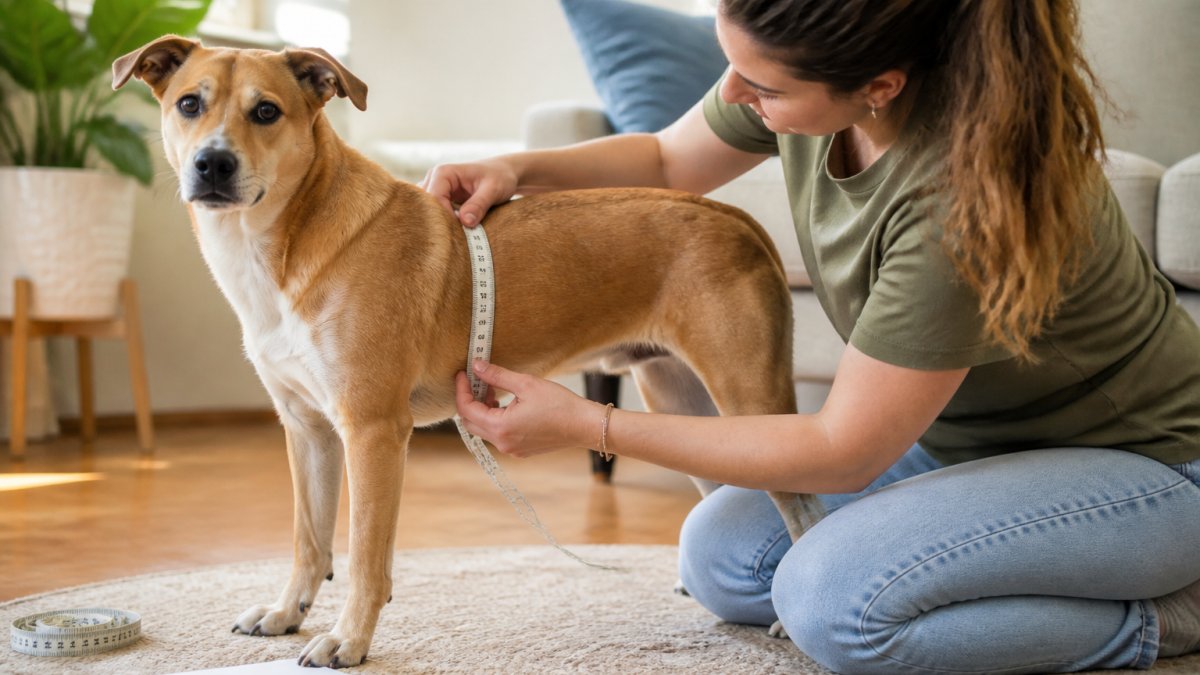
Step 1: Find the Widest Part of the Rib Cage
The widest part of the chest sits right behind the shoulder blades, a few inches back from the front legs. Run your hand along your dog's side until you feel the rib cage at its deepest and broadest point.
Step 2: Wrap the Tape Behind the Front Legs
Circle the tape around the body so it passes behind the front legs, through the armpits, and over the withers (the ridge between the shoulder blades). It should sit near the front legs, not back near the belly.
Step 3: Keep the Tape Flat and Snug
Keep the tape flat and untwisted; a twist adds length and gives a false reading. Pull it snug against the fur without compressing the body, one finger should slide under the tape, and no more.
Step 4: Record the Measurement and Repeat
Write down the number in inches and centimeters, then measure again. If the readings differ by more than half an inch, take a third and use the largest. Both units matter because size charts vary.
| Step | What You Do | Watch For |
|---|---|---|
| 1 | Find the widest part of the rib cage | Don't measure at the shoulders |
| 2 | Wrap behind the front legs | Tape sits in the armpits, not the belly |
| 3 | Keep tape flat and snug | No twists, one finger of slack |
| 4 | Record and repeat | Two readings within half an inch |
How to Measure Dog Girth (and Why It's the Same Thing)
Dog girth and chest size are the same measurement: the distance around the widest part of the rib cage. Brands may call it chest circumference, rib-cage measurement, or chest girth, all four terms point to the same number.
If you know how to measure dog girth, you know how to measure the chest: same tape, same spot, same snug fit.
How to Measure a Dog for a Harness
A harness is sized almost entirely on chest girth. Neck girth is a secondary check, and weight is a rough backup for growing puppies.
- Chest girth: the deciding number for nearly every harness brand
- Neck girth: measured at the base of the neck, where a collar sits, the opening your dog's head passes through
- Weight: a rough cross-check, useful mainly for puppies and brands that publish a weight range alongside girth
Match your chest number to the brand's size chart, then read the adjustment range. Most harnesses list something like "fits 22-28 in chest" rather than a single number.
How Chest Girth Maps to Harness Styles
Different harness styles put the chest strap in different places, so the same girth number can fit one style and not another.
- Step-in harnesses: the dog steps into two leg loops, and the chest strap runs across the front of the chest. These need a slightly more generous girth because the strap crosses the broadest part of the rib cage rather than sitting behind it. A dog at the top of a size range often needs to size up.
- Vest harnesses: a fabric panel covers the chest and back, with straps underneath. Girth matters most: the vest must wrap the full rib cage without gapping, too loose and it slides, too tight and it restricts the shoulder.
- Overhead harnesses: the dog's head goes through a neck opening, then the chest strap clips behind the front legs. These are the most forgiving on girth, but the neck opening must clear the head. If neck girth is close to chest girth, common in bulldogs, pugs, and other brachycephalic breeds, an overhead harness may not go on at all.
Deciding Between Two Sizes
If your dog's chest girth falls between two sizes, the decision depends on the harness style and how much adjustment the brand builds in.
- Size up when the harness has a wide adjustment range, when your dog is still growing, or when the style is a step-in or vest that crosses the broadest part of the chest.
- Size down only when the harness has minimal adjustment and your dog's girth is within half an inch of the smaller size's upper limit.
- Never size down for a front-clip harness. A loose front-clip harness shifts to one side under load and rubs the armpit.
Shoppers often buy the chart's midpoint size and return it because the harness gaps at the sides. When in doubt, size up and tighten the straps.
Fit Checks After the Harness Is On
A correct chest measurement is only the start. Put the harness on, adjust every strap, then run these checks.
- Two-finger rule: you should fit two fingers flat under every strap. One finger means it's too tight; three means it's too loose.
- Chest strap placement: the strap should sit behind the front legs, in the crease where the leg meets the body. If it crosses the front of the shoulder or sits in the armpit, the harness is the wrong size or style.
- Shoulder clearance: have your dog walk a few steps. The front of the harness should not press into the shoulder joint or limit front-leg reach.
- Movement test: jog your dog a short distance or toss a treat a few feet away. Watch for the harness rotating to one side, sliding forward onto the neck, or lifting off the back.
- Rubbing check: after a 10-minute walk, feel under the armpits and along the chest strap. Redness, matted fur, or a hot spot means the fit is wrong.
If the harness fails any check, re-measure the chest girth and compare it against the brand's adjustment range before assuming the size is wrong, sometimes the fix is a different style, not a different size.
How to Measure a Dog for Clothes
Clothing needs three numbers, not one. Chest girth gets you close, but body length and neck girth finish the job.
- Chest girth: around the widest part of the rib cage
- Body length: from the base of the neck to the base of the tail
- Neck girth: around the base of the neck
For a hoodie or tee, chest girth matters most. For a coat or rain jacket, body length matters just as much, since a short coat leaves the back exposed. Measure your dog standing with the tape flat, and write all three numbers down before opening a size chart.
Using a Dog Clothing Size Chart Correctly
A size chart only works if your measurement method matches the brand's. Two brands can both say "measure the chest" and mean different things, one at the widest rib point, another just behind the front legs, a third around the chest plus the front of the shoulders. Before buying, check where the brand says to measure, whether the chart uses inches or centimeters, and how much stretch the fabric has.
Reading the Chart's Measurement Point
Most charts include a small diagram. Compare where its tape line sits to where you measured.
- If the diagram shows the tape behind the front legs, that matches the standard chest girth measurement.
- If the diagram shows the tape across the front of the chest, add roughly half an inch to an inch to your number before comparing.
- If the diagram shows the tape around the shoulders, your chest girth will read smaller than the chart expects. Measure at the shoulder instead for that brand.
When a chart has no diagram, treat the listed girth as the standard behind-the-legs measurement and size up if your dog is near a boundary.
Converting Between Inches and Centimeters
Many international brands publish charts in centimeters. To convert:
- Inches to centimeters: multiply by 2.54. A 24-inch chest girth is 60.96 cm, which most charts round to 61 cm.
- Centimeters to inches: divide by 2.54. A 55 cm chart size is about 21.7 inches.
Round to the nearest whole unit before comparing, and convert in the same direction the chart uses, a half-inch rounding error can push a dog from medium to large on a tight-fitting tee.
Building a Reusable Measurement Record
Write these numbers down once and keep them on your phone. You'll use them every time you shop.
| Measurement | Your Dog | How to Take It |
|---|---|---|
| Chest girth (in) | Around the widest part of the rib cage, behind the front legs | |
| Chest girth (cm) | Same measurement, converted (in × 2.54) | |
| Neck girth (in) | Around the base of the neck, where a collar sits | |
| Body length (in) | Base of the neck to base of the tail, along the spine | |
| Weight (lb) | Current weight, useful for puppy growth tracking | |
| Date measured | Re-measure puppies monthly and adults every few months |
Re-measure puppies every four weeks: chest girth can change by an inch or more in a month, and a harness that fit at 12 weeks may be too tight by 16. Adults with stable weight only need re-measuring if their body condition changes.
When Your Dog Falls Between Sizes
If your dog lands between two sizes, the right call depends on the item and how it's built.
- Harness: size up, then tighten the straps. A slightly loose harness can be adjusted; a tight one has to be returned.
- Coat or hoodie: size up if your dog is still growing, has a thick winter coat, or the fabric has no stretch. Size down only if the item runs large and your dog's girth is within half an inch of the smaller size's upper limit.
- Tight-fitting tee: size up if the chest number is within half an inch of the boundary. Knit fabrics have some give, but not enough to bridge a full size gap.
Puppies and dogs with unusual body shapes, deep-chested breeds like Greyhounds and Dobermans, or long-backed dogs like Dachshunds, often need a size up even when the chart says otherwise. Generic charts assume average proportions, and a deep chest can push a dog into the next size while neck and length still fit the smaller one.
Conclusion
Guessing at dog chest size is the fastest way to end up with gear that rubs, slips, or sits in a drawer.
That's the whole method. Once you have your dog's chest girth, neck girth, and body length on hand, every future purchase gets easier.
Sizing is where most online dog apparel orders go wrong. Shop Tees at The Swell Dogs and find gear that fits your dog and your beach-day vibe.
Frequently Asked Questions
What can I use to measure my dog's chest if I don't have a tape measure?
Use a piece of string, ribbon, or a phone charging cable. Wrap it around your dog's chest at the widest point, mark where the ends meet, then lay it flat against a ruler or yardstick to get the number. A tailor's tape measure is best because it bends easily and won't dig into the fur, but any flexible material works in a pinch. Just make sure it doesn't stretch, or your dog chest size will read larger than it actually is.
How tight should the measuring tape be around a dog's chest?
Snug enough that the tape sits flat against the body without compressing the fur or skin. You should be able to slide one finger under the tape, but not two. If the tape leaves a mark or your dog flinches, it's too tight. For fluffy breeds, press the fur down gently so the tape touches the body, not just the topcoat. Consistency matters more than perfect tension, so measure the same way each time.
What should I do if my dog's chest measurement falls between sizes?
Always size up for harnesses and clothing, especially if your dog is still growing or has a thick coat. A harness that's slightly loose can be adjusted at the straps, but one that's too tight restricts movement and can rub. Check the brand's dog clothing size chart for specific guidance, and look for styles with adjustable chest straps. If you're between sizes on a coat, going up gives room for a sweater underneath.
Should I measure my dog while standing or sitting?
Measure while your dog is standing on all fours. Sitting or lying down compresses the chest and changes the shape of the rib cage, which throws off the measurement. Have a helper hold a treat in front of your dog to keep them still and standing. If your dog won't stand, take three measurements at different times and average them. Standing gives the most accurate dog chest size for harness and clothing sizing.